
 Wes Morris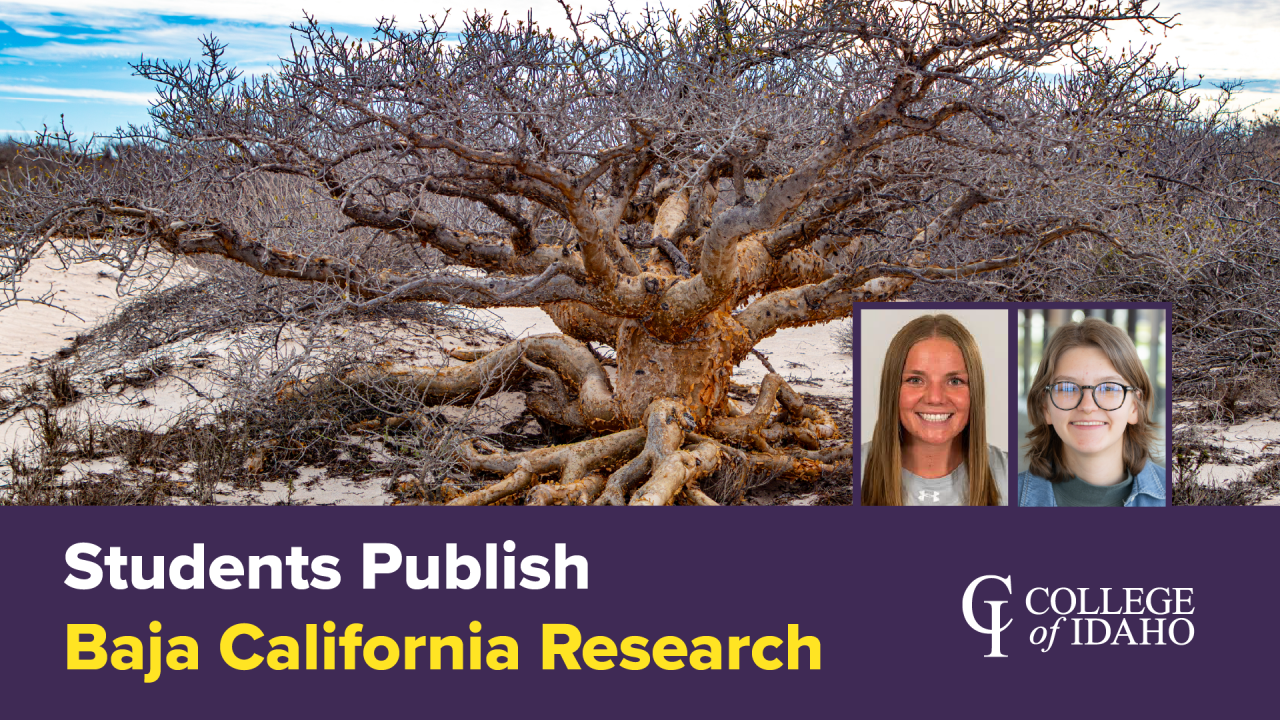
Six College of Idaho students have published research on Baja California’s unique coastal dune ecosystems in the Journal of the Idaho Academy of Science and Engineering, with Emma Campbell ’25 and Emma Redman ’26 serving as lead co-authors.
During Fall 2024, six College of Idaho students traveled to Baja California, Mexico, to explore coastal dune ecosystems as part of a field biology course led by Dr. Anna Himler and Dr. Chris Walser. The experience gave students the opportunity to investigate a unique environment and contribute to research beyond the classroom.
That work has now earned a place in the Journal of the Idaho Academy of Science and Engineering. Emma Campbell ’25 and Emma Redman ’26 served as lead co-authors, an especially notable accomplishment for undergraduate researchers.
Their publication reflects the kind of hands-on learning that allows College of Idaho students to turn curiosity into meaningful scientific work.
The research focused on coastal dune ecosystems along Baja California’s East Cape, an area that supports distinctive plant communities, including endemic species found nowhere else in the world.
Studying these environments helps researchers better understand biodiversity, ecology, and the relationships between plants and their surrounding environments. For the students, the project offered an opportunity to apply classroom knowledge through field-based investigation and collaborative research with faculty mentors.
Six College of Idaho students contributed to the research:
Emma Campbell ’25 — Biology; lead co-author
Emma Redman ’26 — Biology and Political Economy; lead co-author
Jacob Pezonella ’25 — Environmental Studies
Abigail Meldrim ’25 — Biology
Kaiya Pardue ’26 — Biology
Jordan Steele ’27 — Biomedical Sciences
The project was supported by Dr. Anna Himler and Dr. Chris Walser of The College of Idaho’s Biology program.
The publication highlights the value of experiential learning and undergraduate research at The College of Idaho. By participating in field-based scientific investigation, students can apply classroom knowledge to real-world questions, collaborate with faculty mentors, and contribute to scholarship in their fields.
For students interested in biology, environmental studies, and related disciplines, opportunities like this demonstrate how undergraduate education can extend beyond coursework to include hands-on research and scholarly publication.
During Fall 2024, six College of Idaho students traveled to Baja California, Mexico, to explore coastal dune ecosystems as part of a field biology course led by Dr. Anna Himler and Dr. Chris Walser. The experience gave students the opportunity to investigate a unique environment and contribute to research beyond the classroom.
For Emma Campbell ’25 and Emma Redman ’26, serving as lead co-authors represents a particularly meaningful accomplishment. Undergraduate students rarely have the opportunity to take a leading role in published scientific research, making their contribution a testament to the research experience, collaboration, and scientific skills they developed through the project.
Their publication reflects the kind of hands-on learning that allows College of Idaho students to turn curiosity into meaningful scientific work.
Founded in 1891, The College of Idaho is a private liberal arts college in Caldwell, Idaho. The college provides students with opportunities to pursue hands-on learning, faculty-mentored research, and academic exploration across disciplines. Ninety-nine percent of College of Idaho students receive scholarships, and the college serves students from communities across Idaho, including rural and agricultural areas.
2112 Cleveland Blvd, Caldwell, ID 83605
208-459-5011 • 800-2C-IDAHO